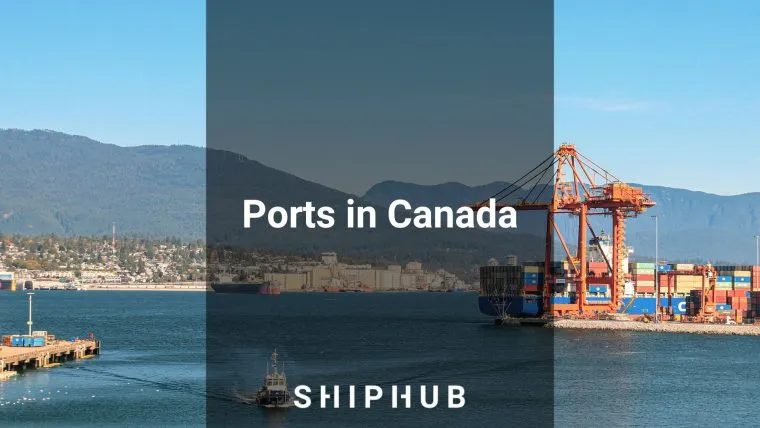
Canada is one of the world’s most trade-dependent economies. With coastlines on the Pacific Ocean, Atlantic Ocean, and the Arctic, Canada’s port system is uniquely positioned to serve global supply chains. In 2025, Canadian ports handled over 7 million TEU in total containerized cargo, with traffic concentrated in a small number of major gateways. Below is a ranking of the largest container ports in Canada.
Major seaports in Canada – a map
Here is a map of Canada with its biggest seaports.

Largest seaports in Canada
5. Port of Prince Rupert (CAPRR)
- Location: British Columbia, Pacific Coast
- Annual container throughput TEU (2025): approx. 1.35 million TEU
- Growth 2024/2025: approx. 6%
- Key commodities: electronics, containerized consumer goods, retail imports, agricultural exports
If you want to ship cargo to/from the US or Asia, choose the Port of Prince Rupert. It is Canada’s northernmost deep-sea port and one of the fastest routes between North America and Asia.
4. Port of Halifax (CAHAL)
- Location: Nova Scotia, Atlantic Coast
- Annual container throughput TEU (2025): approx. 1.55 million TEU
- Growth 2024/2025: approx. 4%
- Key commodities: automotive parts, containerized general cargo, food products, industrial goods
The Port of Halifax is Canada’s leading East Coast container gateway, serving transatlantic trade and inland North American markets. It is a key alternative routing option when congestion affects the US East Coast ports.
3. Port of Montréal (CAMTR)
- Location: Quebec, along the St. Lawrence River
- Annual container throughput TEU (2025): approx. 1.75 million TEU
- Growth 2024/2025: approx. 3%
- Key commodities: agri-food products, containerized consumer goods, machinery, chemicals
The Port of Montréal is Canada’s largest inland container port and a critical hub for Central Canada. It connects directly to Europe, the Mediterranean, and North Africa.
2. Port of Vancouver (CAVAN)
- Location: British Columbia, Pacific Coast
- Annual container throughput TEU (2025): approx. 3.7 million TEU
- Growth 2024/2025: approx. 2.5%
- Key commodities: electronics, forest products, containerized consumer goods, agricultural exports
The Port of Vancouver is Canada’s largest and most diversified port, handling containers, bulk, and breakbulk cargo.
1. Largest container port in Canada: Port of Vancouver & Deltaport terminals (Pacific Gateway)

- Location: British Columbia, Pacific Coast
- Annual container throughput TEU (2025): approx. 4.0 million TEU
- Growth 2024/2025: approx. 3%
- Key commodities: containerized imports from Asia, retail goods, electronics, machinery, and export of agri-food products
Even though it is often reported under the Port of Vancouver authority, Canada’s largest container gateway is the Vancouver–Deltaport container system, which dominates national container volumes.

Compare shipping options to and from Canada
If you’re shipping through seaports in Canada, don’t rely on a single quote or routing.
Find reliable, vetted freight forwarders on ShipHub.co and compare multiple shipping quotes for your route and cargo. Check other posts about the biggest ports all over the world.