Saudi Arabia sits at the crossroads of some of the world’s most important shipping lanes – the Red Sea corridor connecting Europe and Asia, and the Arabian Gulf linking the Middle East to South Asia and the Far East. Saudi Arabia climbed to 15th place in the global container handling ranking. Three Saudi ports now sit in the world’s top 100 container ports. What are the top ports in Saudi Arabia?
Major Container Ports in Saudi Arabia – Overview
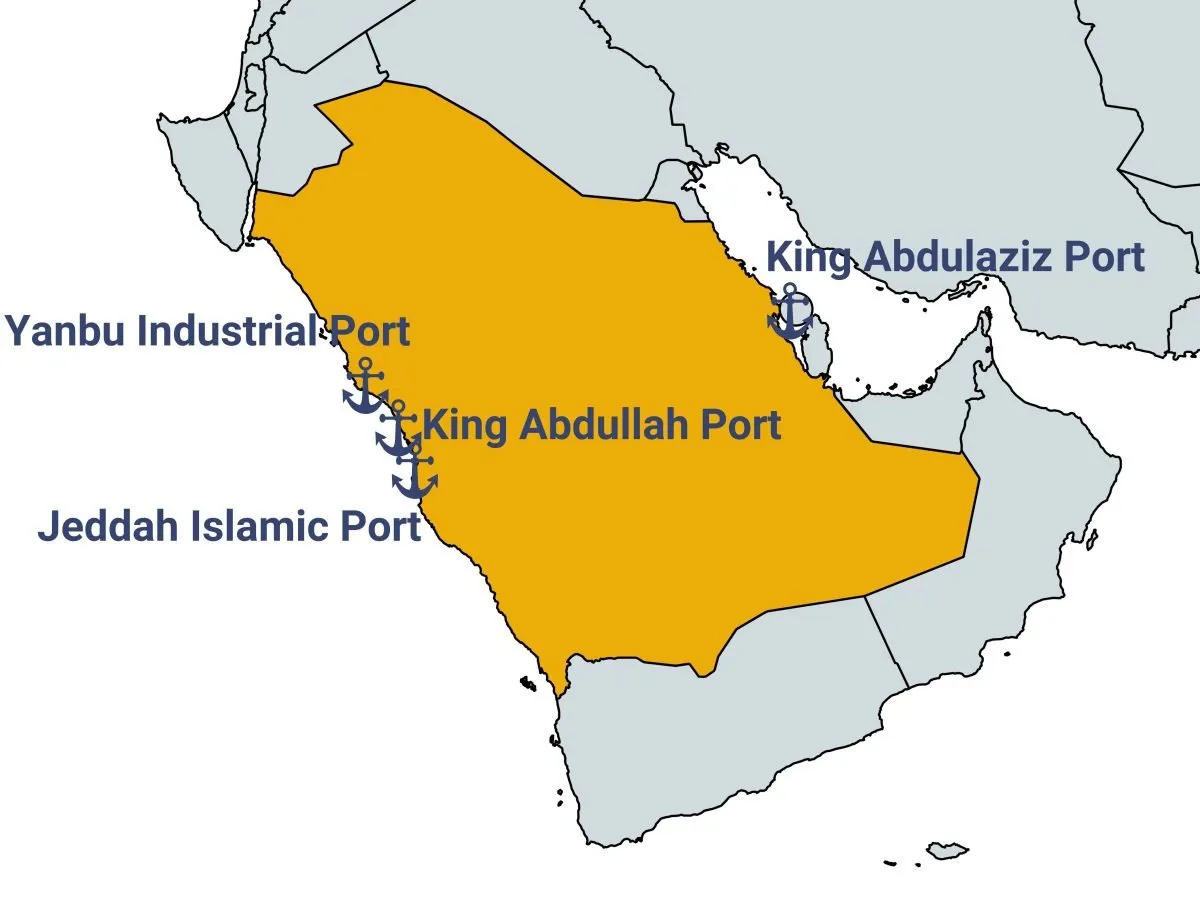
Saudi Arabia’s port system is managed by the Saudi Ports Authority, known as Mawani. The Kingdom has ports on two coasts: the Red Sea (Jeddah, King Abdullah Port, Yanbu) and the Arabian Gulf (Dammam, Jubail). Under Saudi Vision 2030, the government has committed tens of billions to transform the Kingdom into a global logistics hub, with plans to develop 18 logistics zones across major ports by 2030.
4. King Abdullah Port (SAKAP)
- Location: King Abdullah Economic City, Red Sea coast north of Jeddah
- 2024 Container Throughput: approximately 500,000 TEU (down 82.7% from about 3 million TEU in 2023)
- Key Commodities: Transshipment containers (primary function)
- Main Trade Routes: Asia–Europe, Africa, Mediterranean – when Red Sea routes are active
King Abdullah Port had been one of the fastest–growing ports in the world in the years leading up to 2024, pulling in major shipping line services – particularly from MSC – and establishing itself as a significant transshipment hub on the Asia–Europe corridor. Then the Red Sea crisis hit. Volumes collapsed 82.7% in 2024 as shipping lines rerouted around the Cape of Good Hope, bypassing the Red Sea entirely. Where KAP handled 389 vessels above 15,000 TEU capacity in 2023, just one such vessel docked in 2024.
3. Yanbu Industrial Port (SAYAN)
- Location: Yanbu, Red Sea coast, Madinah region
- Key Commodities: Crude oil, refined petroleum, petrochemicals, industrial equipment
- Main Trade Routes: Europe, Asia, East Africa
Yanbu is Saudi Arabia’s industrial port on the Red Sea and the country’s top export port by total tonnage – accounting for 51.1% of total Saudi export volumes in 2024. It serves the Yanbu Industrial City, one of the Kingdom’s largest petrochemical production hubs, and handles vast volumes of crude oil, refined products, and chemical exports. Container throughput at Yanbu is limited; it is primarily a bulk and liquid industrial port rather than a container gateway. Its significance lies in energy supply chains rather than general cargo.
2. King Abdulaziz Port, Dammam (SADMM)
- Location: Dammam, Eastern Province, Arabian Gulf coast
- 2024 Container Throughput: approximately 3.2 million TEU (+43% year–on–year)
- Key Commodities: Consumer goods, industrial equipment, vehicles, food products
- Main Trade Partners: China, India, South Korea, UAE, Kuwait
Dammam’s King Abdulaziz Port was 2024’s standout performer in Saudi Arabia. While Red Sea ports were bleeding volume, Dammam surged 43% – shippers and shipping lines rapidly redirected cargo through the Gulf coast as the alternative to the troubled Red Sea corridor. The port now handles approximately 51% of Saudi Arabia’s standard container traffic and ranks first among Saudi ports for container volume.
Operated primarily by Saudi Global Ports (SGP), a joint venture backed by PSA International (Singapore), the terminal reached 3.2 million TEUs in 2024 and has already surpassed a cumulative milestone of 15 million TEUs in total lifetime throughput. A major expansion is underway under a 30–year concession agreement, with the port deploying 5G technology and smart port systems as part of the Vision 2030 logistics hub ambition. The port is also the natural gateway to Riyadh – connected to the capital via road and rail – and to the broader GCC market.
1. Largest Container Port in Saudi Arabia: Jeddah Islamic Port (SAJED)
- Location: Jeddah, Makkah region, Red Sea coast
- 2024 Container Throughput: approximately 3.7 million TEU (down 33.4% from 2023)
- Key Commodities: Consumer goods, food products, textiles, machinery, Hajj–related cargo
- Main Trade Partners: China, India, Europe, East Africa
Jeddah Islamic Port is Saudi Arabia’s largest and most strategically significant port under normal operating conditions. Located on the Red Sea, it handles approximately 65% of Saudi Arabia’s sea imports and serves as the primary gateway for the western half of the Kingdom – including the holy cities of Makkah and Madinah, which generate enormous seasonal cargo demand tied to Hajj and Umrah pilgrimages.
In 2024, Jeddah saw a 33.4% drop in container volumes due to Red Sea shipping disruption – a dramatic decline that brought volumes down to approximately 3.7 million TEUs from an estimated 5.5 million in 2023. Only 11 vessels above 15,000 TEU docked at Jeddah in 2024, compared to 157 the year before. Despite the crisis impact, Jeddah jumped from 41st to 32nd in the global Lloyd’s List ranking for 2024 – a reflection of how badly competing ports were also affected by global route changes.
Jeddah is best for: imports destined for western Saudi Arabia, Makkah, Madinah, and Hajj–related supply chains. When Red Sea routes are secure, it also functions as a transshipment hub for East Africa and the Horn of Africa.
Ports in Saudi Arabia – Quick Comparison
| Port | TEU 2024 | Best for | Region served |
|---|---|---|---|
| King Abdullah Port (SAKAP) | approx. 500,000 (crisis impact) | Transshipment; stable Red Sea operations | Red Sea, Jeddah corridor |
| Yanbu Industrial Port (SAYAN) | Mainly bulk/energy cargo | Petrochemicals, industrial cargo | Medina region, Red Sea industry |
| King Abdulaziz Port Dammam (SADMM) | approx. 3.2M | Gulf gateway, Arabian Gulf trade | Riyadh, Eastern Province, GCC |
| Jeddah Islamic Port (SAJED) | approx. 3.7M | Red Sea gateway, transshipment | Mecca, Western Saudi Arabia, Africa |

Ready to Ship Through Saudi Arabia? Find a Freight Forwarder on ShipHub
Saudi Arabia’s port landscape changed dramatically in 2024, and it continues to evolve in 2025. A freight forwarder with current, on-the-ground knowledge of Jeddah and Dammam operations – including Red Sea route alternatives, customs clearance timelines, and Vision 2030 infrastructure changes – is essential for reliable Saudi supply chains. Compare freight forwarders for Saudi Arabia on ShipHub →