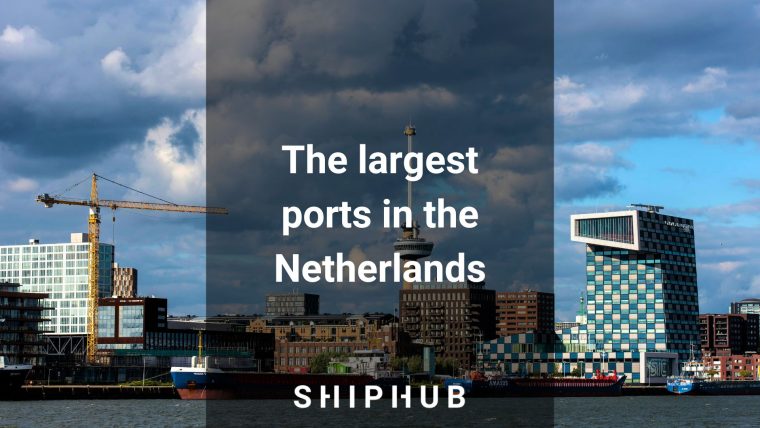
The Netherlands has been a maritime trading nation since the Dutch Golden Age, and that heritage continues in the numbers today. For example, Rotterdam is the largest container port in Europe and the twelfth largest in the world. See the ranking of largest ports in the Netherlands.
Major container ports in the Netherlands – overview

The Dutch port system is anchored by Rotterdam, which sits at the mouth of the Rhine-Maas-Scheldt delta and provides direct access to the European inland waterway network, which is the largest and most developed barge transport system in the world. Amsterdam serves as a complementary hub for bulk, energy, and cruise traffic. North Sea Port and Moerdijk handle regional and industrial cargo.
4. North Sea Port (Vlissingen / Terneuzen)

- Location: Zeeland and Flemish provinces, Netherlands-Belgium border
- Tonnage 2025: 15M
- Key Commodities: Chemicals, steel, agricultural products, bulk cargo
- Main Trade Routes: Atlantic, North Sea, intra-European
North Sea Port was formed in 2018 through the merger of the ports of Vlissingen (Flushing) and Terneuzen ea and handles significant volumes of bulk, break-bulk, and liquid cargo for the chemical and agricultural sectors. The port plays a critical role in the industrial supply chains of Zeeland and Flemish Belgium.
3. Port of Moerdijk

- Location: North Brabant, southern Netherlands
- Tonnage 2025: 62.1M
- Key Commodities: Chemicals, food products, general cargo, container storage
- Main Trade Routes: Inland barge to Rotterdam, short-sea to UK and Belgium
Moerdijk functions primarily as a chemical industry and inland barge hub, positioned between Rotterdam and Antwerp in the heart of the European logistics corridor. Its barge connections to Rotterdam make it a cost-effective overflow and distribution point for companies that need inland waterway connectivity without paying premium Rotterdam terminal rates.
2. Port of Amsterdam

- Location: Amsterdam, North Holland (North Sea Canal)
- Tonnage 2025: 128.5M
- Key Commodities: Cocoa, oil products, coal, agri-bulk, fuel oil
- Main Trade Routes: North Sea, Atlantic, global bulk routes
Amsterdam is the world’s largest cocoa and cacao processing port – roughly a third of Europe’s cocoa processing takes place within the port’s industrial complex. It is also a major fuel oil and petroleum hub, with storage and blending facilities that serve the entire Amsterdam-Rhine-Ruhr industrial corridor. While not a primary container port, Amsterdam handles significant volumes of breakbulk and agri-bulk. The North Sea Canal connecting Amsterdam to the sea handles vessels up to Post-Panamax size.
1. Largest Port in the Netherlands: Port of Rotterdam (NLRTM)

- Location: Rotterdam, South Holland (Rhine-Maas delta, North Sea)
- Tonnage 2025: 428.4M
- Key Commodities: All container cargo, oil, chemicals, agri, LNG
- Main Trade Routes: Asia, Americas, Middle East, Africa, intra-Europe
Rotterdam is Europe’s largest port and one of the world’s great maritime hubs. Located at the confluence of the Rhine and Maas rivers, it is uniquely positioned as the gateway to the European hinterland – its barge network alone connects the port to over 500 inland terminals across the Netherlands, Germany, Belgium, France, and Switzerland. About 40% of Rotterdam’s container traffic moves onward by barge, making it the most inland-river-integrated major port on earth.
Netherlands ports at a glance – quick comparison
| Port | Tonnage 2025 | Best For | Key Region Served |
|---|---|---|---|
| North Sea Port (Vlissingen/Terneuzen) | 15 M | Bulk, chemicals, industrial cargo | Zeeland, Belgium border |
| Port of Moerdijk | 62.1 M | Chemical industry, inland barge | North Brabant, Antwerp corridor |
| Port of Amsterdam | 128.5 M | Bulk, energy, cocoa, agri | Amsterdam, North |
| Port of Rotterdam | 428.4 M | All cargo types, European distribution | All of Europe via Rhine, barge, rail |

Ready to ship through the Netherlands? Find a freight forwarder on ShipHub
For European distribution, Rotterdam is often brought up in conversation. But getting the most out of Rotterdam, whether it’s a barge routing to the Rhine, rail to Eastern Europe, or direct delivery to major retailers, requires a freight forwarder who knows the port’s complex terminal ecosystem. Working with an experienced freight forwarder is key. Connect with reliable freight forwarders and compare their offers for free on ShipHub →