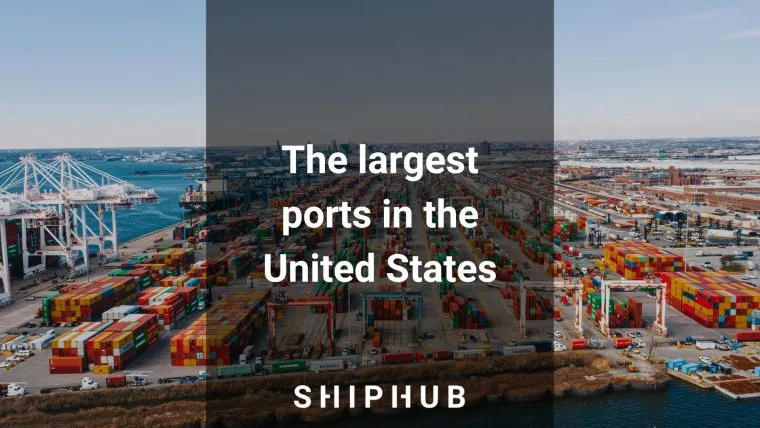
The United States is the world’s largest import market and one of its most important export economies. For global shippers, understanding the differences between US ports is essential. Geography, hinterland connectivity, shipping line rotations, and commodity specialization vary significantly between the coasts. Below is a ranking of the five biggest ports in the United States.
Major container ports in the United States – overview
The US port system is managed by a mix of port authorities, private terminal operators, and federal bodies. The top five container ports — Los Angeles, Long Beach, New York/New Jersey, Savannah, and Houston — together handle roughly 60% of the country’s containerized trade. West Coast ports dominate Asia-Pacific trade lanes; East Coast ports serve Europe, the Mediterranean, and increasingly Asia via the Panama Canal.

5. Port of Houston (USHOU)

- Location: Houston, Texas (Gulf of Mexico)
- 2024 Container Throughput: 4.3 million TEU
- Key Commodities: Petroleum, chemicals, plastics, steel, cotton, agricultural goods
- Main Trade Routes: Latin America, Europe, Middle East, Asia
Houston is the US Gulf Coast’s dominant container port and the nation’s top port by total cargo tonnage. Its container throughput is supported by the largest petrochemical complex in the country, making it uniquely positioned for energy-related imports and exports. The Bayport Container Terminal is one of the most technologically advanced in the United States.
4. Port of Savannah (USSAV)

- Location: Savannah, Georgia (Atlantic coast)
- 2024 Container Throughput: 5.7 million TEU
- Key Commodities: Automotive parts, retail goods, consumer electronics, agricultural products
- Main Trade Routes: Asia, Europe, Latin America
Savannah is the fastest-growing major container port in the United States and the largest single container terminal on the East Coast by land area. The port’s garden-style terminal layout — where containers are spread across a large footprint rather than stacked high — minimizes congestion and produces some of the fastest truck turn times in the country. Rail connections to the Midwest make it competitive for inland distribution well beyond its immediate hinterland.
3. Port of New York and New Jersey (USNYC)

- Location: New York/New Jersey (Atlantic coast)
- 2024 Container Throughput: 8.8 million TEU (+11.4%)
- Key Commodities: Consumer goods, apparel, food, machinery, pharmaceuticals
- Main Trade Partners: China, India, Germany, Italy, Netherlands
The Port of New York and New Jersey is the largest container port on the US East Coast and the third largest in the nation. It serves the most populated and economically dense region in the United States — greater New York, New Jersey, and New England — and handles a diverse mix of cargo from finished consumer goods to high-value pharmaceuticals and luxury goods from Europe. Its deep-water channels and proximity to the Northeast US population centers make it the natural gateway for European and Mediterranean trade into the US market.
2. Port of Long Beach (USLGB)

- Location: San Pedro Bay, Southern California (Pacific coast)
- 2024 Container Throughput: 9.8 million TEU (full-year record)
- Key Commodities: Consumer electronics, apparel, furniture, retail goods, automotive parts
- Main Trade Routes: Asia (China, Vietnam, Japan, South Korea), Mexico
Long Beach, an adjacent port to Los Angeles, shares the San Pedro Bay complex and together with LA forms the largest container port cluster in the Western Hemisphere. Long Beach is home to some of the most technologically advanced terminals in North America, including the fully automated Long Beach Container Terminal (LBCT), which features remote-controlled gantry cranes and automated stacking.
1. Largest Port in the United States: Port of Los Angeles (USLAX)

- Location: San Pedro Bay, Southern California (Pacific coast)
- 2024 Container Throughput: 10.2 million TEU (+nearly 20% year-on-year)
- Key Commodities: Consumer electronics, apparel, furniture, toys, machinery
- Main Trade Partners: China, Vietnam, Japan, South Korea, Taiwan
The Port of Los Angeles is North America’s undisputed number one container gateway and has held that position for over 20 years. For any Asia-origin cargo destined for California, Arizona, Nevada, or the broader western US, Los Angeles is almost always the fastest and most cost-effective entry point. For Midwest or East Coast distribution, compare total door-to-door costs carefully — East Coast all-water services have gained competitiveness since the Panama Canal expansion.
US ports at a glance – quick comparison
| Port | 2025 TEU | Best For | Key Region Served |
| Houston (USHOU) | 4.3M | Energy, chemicals, Gulf Coast | Texas, Gulf Coast, Midwest |
| Savannah (USSAV) | 5.7M | Southeast US, automotive, retail | Georgia, Southeast, Midwest |
| New York/New Jersey (USNYC) | 8.8M | East Coast gateway, Europe/Med | Northeast USA, Midwest |
| Long Beach (USLGB) | 9.8M | Asia imports, West Coast | Southern California, western USA |
| Los Angeles (USLAX) | 10.2M | Largest US hub, all Asia trade | Southern California, nationwide |

Ready to ship through the US? Find a freight forwarder on ShipHub
Whether your container is entering through Los Angeles from Shanghai, clearing customs in New York from Hamburg, or transiting through Houston from Brazil, the right freight forwarder makes the difference between smooth delivery and costly delays. Compare freight forwarders for US trade lanes for free on ShipHub →