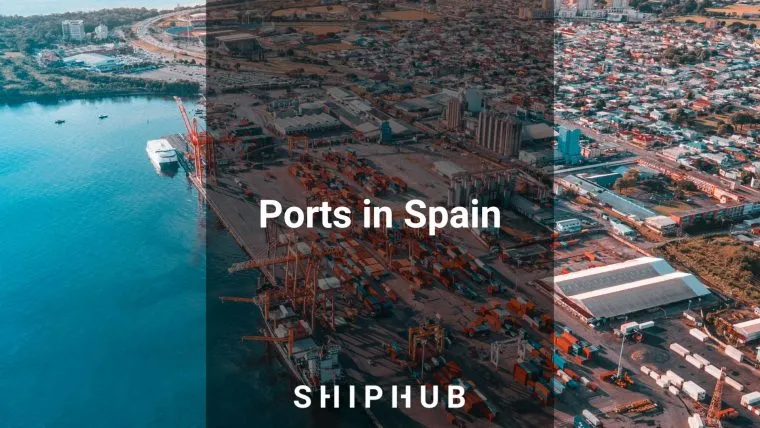
Spain sits at one of the most strategically valuable crossroads in the world — where the Mediterranean meets the Atlantic, where Europe faces Africa, and where Asia-Europe shipping lanes converge. It’s no accident that Spanish ports rank second in Europe for total container traffic, right behind the mighty Benelux corridor. Below is a ranking of the biggest container seaports in Spain, based on 2024 throughput data.
Major Seaports in Spain – Overview
Spain operates 46 ports of general interest, all overseen by Puertos del Estado, the state body that manages the country’s commercial port network. The four dominant container ports — Valencia, Algeciras, Barcelona, and Las Palmas — handle the vast majority of Spain’s containerized trade. Bilbao rounds out the top five as the gateway to Northern Spain and Atlantic Europe.
In 2024, Spanish ports handled over 557 million tonnes of cargo combined, generating around €24 billion for the national economy. Three Spanish ports are among the EU’s top ten for containers. If you’re importing or exporting through Europe, at least one of them is almost certainly part of your supply chain — or should be.
Each port has a distinct geographic role, cargo specialty, and set of trade routes. Choosing the right one can make a real difference to your transit times, costs, and customs complexity.

5. Port of Bilbao (ESBIO)

- Location: Bilbao, Basque Country, northern Spain (Bay of Biscay)
- 2024 Container Throughput: ~1 million TEU
- Key Commodities: Iron, steel, chemicals, vehicles, industrial goods
- Main Trade Routes: Northern Europe, UK, Americas
The Port of Bilbao is northern Spain’s maritime gateway and the country’s main link to the UK and Northern Europe. While it handles roughly a fifth of what Valencia does in container terms, Bilbao plays a different and irreplaceable role: it’s built for industrial cargo.
The Basque Country is one of Spain’s most industrially dense regions — steel, automotive, chemicals, and heavy manufacturing all flow through Bilbao. The port has strong ro-ro capabilities for vehicles and heavy equipment, making it a natural hub for industrial exporters and importers who need Atlantic-facing connections.
Post-Brexit, Bilbao took on added importance for Spain-UK trade. Short-sea shipping routes between Bilbao and UK ports like Portsmouth and Poole run regularly, and the port maintains solid connections to Northern Europe and the Atlantic coast of France.
⚠️ Important Note for UK Importers: Since Brexit, customs requirements between Spain and the UK have changed significantly. Make sure your freight forwarder is experienced with post-Brexit documentation if you’re moving goods through Bilbao to or from the UK.
Bilbao is best for: Northern Spain importers and exporters. Industrial goods — steel, chemicals, heavy equipment. Trade with the UK, Ireland, and Northern Europe.
4. Port of Las Palmas (ESLPA)

- Location: Gran Canaria, Canary Islands (Atlantic Ocean)
- 2024 Container Throughput: ~1.32 million TEU
- Key Commodities: Frozen produce, consumer goods, transshipment cargo
- Main Trade Routes: Europe–West Africa, Europe–Americas, Atlantic feeder network
Las Palmas is the wild card in Spain’s port system. Technically located off the northwestern coast of Africa, the Canary Islands sit at the intersection of some of the Atlantic’s busiest shipping lanes — connecting Europe to West Africa, South America, and beyond.
Around 56% of Las Palmas’s container business is transshipment, making it the second-most transshipment-intensive port in Spain after Algeciras. It’s an important hub for frozen food — particularly fish products — and serves as a critical refueling and redistribution point for ships crossing the Atlantic.
In 2025, Las Palmas has been closing in on Marseille in the EU port rankings, driven by strong 15.7% growth in the first nine months of the year. For shippers targeting West African markets or operating in the Atlantic trade, this port punches above its weight.
💡 Shipper’s Tip: Las Palmas is not typically on the radar for Spain-mainland importers — but if your supply chain touches West Africa or the Atlantic islands, it’s worth evaluating as a transshipment option. Canary Islands goods also benefit from a special EU tax regime.
Las Palmas is best for: Cargo headed to West Africa or the Americas. Frozen and perishable goods. Atlantic transshipment.
3. Port of Barcelona (ESBCN)

- Location: Barcelona, Catalonia, northeastern Mediterranean coast
- 2024 Container Throughput: ~3.9 million TEU
- Key Commodities: Textiles, electronics, chemicals, consumer goods, cruise cargo
- Main Trade Routes: Asia-Europe, intra-Mediterranean, Americas
Barcelona had a remarkable 2024. It was the standout growth story among Spain’s major ports, with transshipment volumes alone jumping nearly 32% — partly driven by shipping companies rerouting around the Red Sea via the Cape of Good Hope. When global supply chains shift, Barcelona benefits from being a well-connected Western Mediterranean hub.
The port serves one of Europe’s most economically active urban regions. Catalonia accounts for a significant share of Spanish industrial output, and Barcelona’s port is its direct link to global trade. Beyond containers, Barcelona is also Spain’s busiest cruise port — which creates a dual identity as a commercial and passenger gateway.
Barcelona is the third largest Spanish port for containers, and for most shippers, it functions as the natural choice for cargo headed to northeastern Spain, southern France, and the Balearic Islands. It also has strong connections to Asian markets, with Asia-Med loops linking it directly to Chinese manufacturing hubs.
💡 Shipper’s Tip: Barcelona’s 2024 growth was partly a one-time surge from trade route disruption. In 2025, volumes have moderated. That said, the port’s structural importance for Catalonia and its feeder role in the western Med remain solid for the medium term.
Barcelona is best for: Importers supplying northeastern Spain, southern France, or the Balearic Islands. Consumer goods, fashion, electronics. Shippers looking for a secondary Western Med hub alongside Valencia.
2. Port of Algeciras (ESALG)

- Location: Bay of Gibraltar, Andalusia, southern Spain
- 2024 Container Throughput: ~4.7 million TEU
- Key Commodities: Oil and refined petroleum, machinery, transshipment containers
- Main Trade Routes: Asia-Europe, Americas, West Africa
If Valencia is Spain’s Mediterranean engine, Algeciras is its transatlantic pivot. Positioned at the Strait of Gibraltar — one of the narrowest and most heavily trafficked maritime chokepoints in the world — Algeciras handles the cargo that needs to go everywhere at once.
Roughly 85% of Algeciras’s container traffic is transshipment, meaning containers arrive from large deep-sea vessels and are redistributed onto feeder ships bound for other ports across the Mediterranean, West Africa, and the Atlantic islands. Over 100 mega-vessels call at Algeciras every year, many of them carrying 18,000+ TEU per voyage.
The port’s biggest challenge right now is competition. Tanger Med, directly across the Strait in Morocco, handled over 10.24 million TEU in 2024 and is growing at nearly 19% annually. Algeciras traffic stagnated in 2024 partly because of that rivalry. That said, Algeciras retains key advantages: it’s EU territory, it offers seamless EU customs processing, and it has decades of operational experience handling the world’s largest vessels.
⚠️ Important Note: If your cargo needs to clear EU customs or benefit from EU Free Trade Agreements, Algeciras has a significant regulatory advantage over Tanger Med. Goods entering through Algeciras are already inside the EU single market.
Algeciras is best for: Transshipment to secondary Mediterranean or Atlantic ports. Cargo from the Americas destined for European distribution. High-volume FCL where feeder connectivity matters.
1. Largest Port in Spain: Port of Valencia (ESVLC)

- Location: Valencia, eastern Mediterranean coast (Valencian Community)
- 2024 Container Throughput: ~5.5 million TEU
- Key Commodities: Agri-food products, automotive parts, chemicals, machinery, consumer goods
- Main Trade Partners: China, USA, Algeria, Turkey, India
The Port of Valencia is Spain’s undisputed number one for containerized cargo and the fourth-largest container port in the EU — sitting just behind Rotterdam, Antwerp-Bruges, and Hamburg. That’s a remarkable position for a Mediterranean port, and it didn’t happen by accident.
Valencia’s rise is built on geography and connectivity. The port sits at the heart of the Asia-Europe trade lane, with direct deep-sea services linking it to Shanghai, Ningbo, and Singapore. Its 12 km of quayside, over 300 acres of storage, and a designated Free Trade Zone give shippers the scale and flexibility to move large volumes efficiently.
In 2024, China alone accounted for over 702,000 containers handled at Valencia, followed by the United States at 368,000 TEU. Together, those two countries represent roughly a third of all Valencia’s container traffic — a telling sign of how globally connected this port really is.
💡 Shipper’s Tip: If you’re importing from Asia into Spain or re-exporting within the Mediterranean, Valencia is typically your most competitive entry point. The port’s rail freight connections to Madrid and the interior of Spain are also growing fast — containers loaded by train increased nearly 6% in the first half of 2025 alone.
A major northern expansion is already approved, with a new terminal targeting 5 million additional TEU of capacity by 2030. MSC is co-investing over €1 billion in the project. For long-term supply chain planning, Valencia’s infrastructure trajectory points firmly upward.
Valencia is best for: Importers and exporters trading with Asia, North America, or North Africa. Ideal for FCL shipments into Spain’s interior or Mediterranean distribution.
Spain’s Ports at a Glance – Quick Comparison
| Port | 2024 TEU | Best For | Key Region Served |
|---|---|---|---|
| Valencia | ~5.5M | Asia imports, FCL, Mediterranean distribution | Eastern Spain, inland Iberia |
| Algeciras | ~4.7M | Transshipment, Americas, Africa | Southern Spain, global relay |
| Barcelona | ~3.9M | Consumer goods, NE Spain, Mediterranean | Catalonia, Balearics, S. France |
| Las Palmas | ~1.32M | Atlantic transshipment, West Africa | Canary Islands, Atlantic lanes |
| Bilbao | ~1M | Industrial cargo, UK/N. Europe | Northern Spain, Basque Country |
How to Choose the Right Spanish Port for Your Shipment
Picking the right port isn’t just about TEU rankings. Here’s what actually matters for shippers:
1. Where is your cargo going after it arrives?
If it’s distributing across Spain’s interior, Valencia’s rail connections are hard to beat. If it’s going to Catalonia or southern France, Barcelona is closer. For northern Spain, Bilbao saves road kilometers.
2. Is your shipment FCL or LCL?
All five major Spanish ports handle FCL. For LCL consolidation, Valencia and Barcelona have the widest range of consolidation services.
3. Do you need transshipment?
Algeciras and Las Palmas are built for it. Valencia and Barcelona can handle transshipment but are primarily import-export ports.
4. What’s your commodity?
Perishables? Valencia and Las Palmas have strong cold chain infrastructure. Industrial bulk? Choose Bilbao or Algeciras. Consumer goods from Asia? Look into Valencia or Barcelona.
5. Are you trading outside the EU?
If your cargo needs EU customs clearance, make sure your freight forwarder is experienced with Puertos del Estado procedures and Spain’s 21% VAT on imports.

Ready to Ship Through Spain? Find a Freight Forwarder on ShipHub
Whether your container is heading into Valencia from Shanghai, transshipping through Algeciras, or landing in Bilbao from the UK, having the right freight forwarder makes all the difference. Rates, routing options, transit times, and customs expertise vary significantly between providers.
Compare freight forwarders and get instant quotes on ShipHub →
ShipHub connects importers and exporters with verified freight forwarders who know Spanish ports inside out. You can compare multiple quotes for your specific cargo and route — FCL, LCL, ro-ro, or breakbulk — and book the one that works best for your timeline and budget.
Don’t settle for the first quote you get. Use ShipHub to see your options side by side.