If you ship or receive goods by air, sooner or later you will run into the air waybill. It is one of the most important documents in air freight, and getting it right matters for smooth customs clearance and on-time delivery. This guide explains what an air waybill is, what it contains, how to read its number, the difference between a master and a house air waybill, and how the electronic version (e-AWB) has changed the process.
What is an air waybill (AWB)?
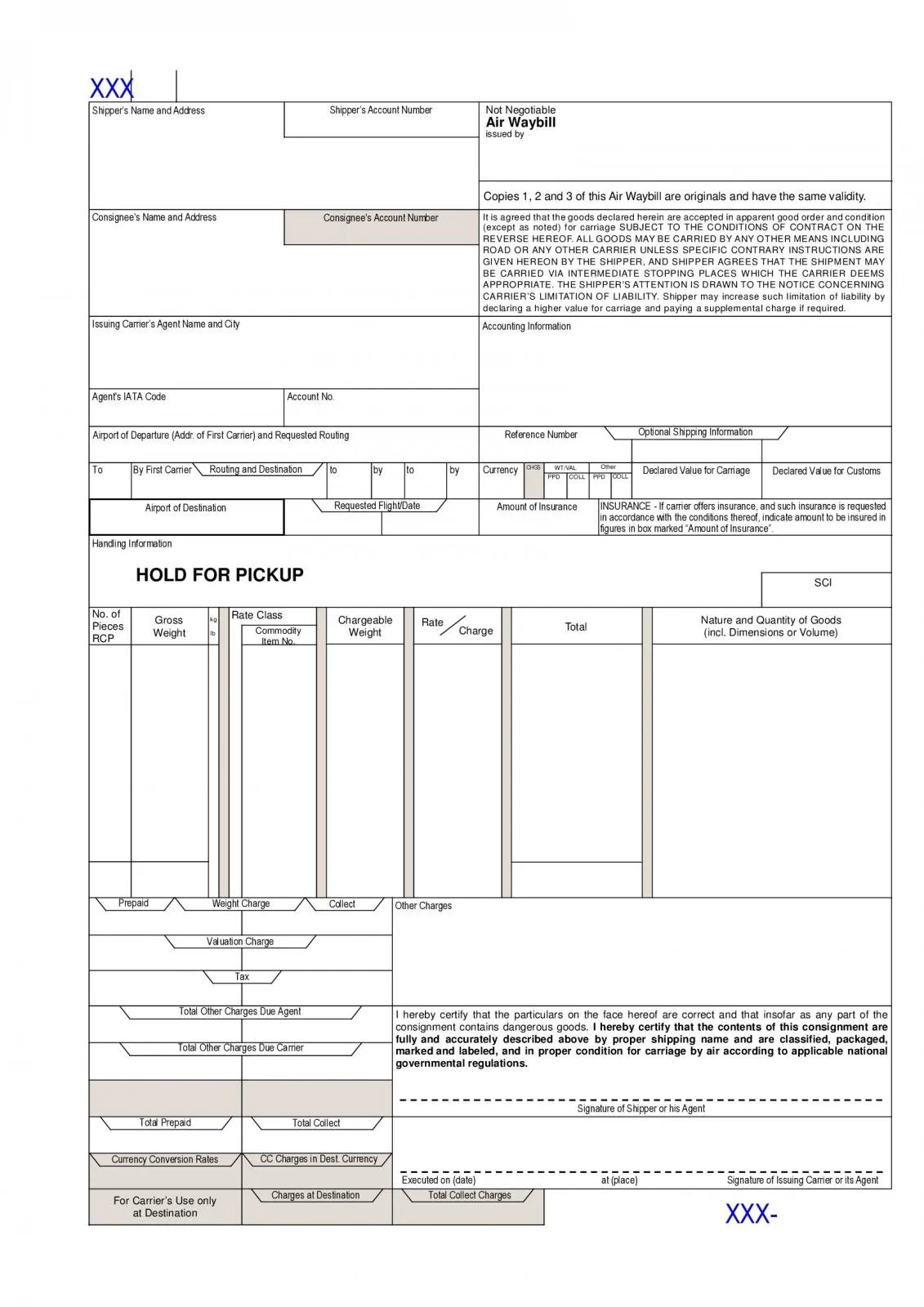
The air waybill, also called an air consignment note, is a document that governs the transport of cargo by air. It forms a contract of carriage between the shipper (the party sending the goods) and the carrier (the airline). It is prepared by the shipper or the freight forwarder acting on their behalf, and it is signed by the carrier or the carrier’s agent, who confirms receipt of the consignment and sets the terms and conditions of transport.
What functions does the air waybill serve?
A single air waybill fills several roles at once:
- Contract of carriage between the shipper and the airline, with the conditions of carriage printed on the reverse of each original.
- Receipt of goods, confirming the carrier has accepted the cargo for transport.
- Freight bill, showing charges and how they are to be paid.
- Customs document, providing the details needed for import and export formalities.
- Tracking reference, since the AWB number lets you follow the shipment from origin to destination.
Is an air waybill negotiable?
An air waybill is a non-negotiable document, so it cannot be endorsed or transferred to pass ownership of the goods to another party. This is a fundamental difference from a negotiable ocean bill of lading, which can serve as a document of title. Because the AWB does not transfer ownership, the goods are released to the named consignee once they arrive and any charges and customs requirements are settled.
What does an air waybill contain?
The shipper is responsible for completing the AWB correctly and bears the cost of any errors, so accuracy matters. The document is typically filled out in English, by hand or electronically, and usually includes:
- place and date the document was issued,
- shipper’s name, full address, and signature,
- consignee’s name and full address,
- carrier and forwarder details,
- shipper and consignee reference numbers,
- a description of the goods, including packaging, number of packages, weight (in kilograms or pounds), dimensions, and country of origin,
- declared value of the goods,
- freight charges and how they are settled,
- information required for customs formalities,
- any additional details required by the contract or the carrier’s regulations.
Complete every field legibly and accurately, because a single mistake can delay customs clearance or trigger extra charges.
How to read an air waybill number
Every air waybill carries a unique 11-digit number, usually written as XXX-XXXXXXXX. It breaks down into three parts:
- First 3 digits, the airline prefix. This IATA-assigned code identifies the issuing carrier. For example, 020 is Lufthansa Cargo and 176 is Emirates SkyCargo.
- Next 7 digits, the serial number. A unique sequence assigned by the airline to that specific shipment.
- Final digit, the check digit. A validation figure derived from the serial number (using a modulo 7 calculation) that helps catch typos.
A common point of confusion: the first three digits identify the airline, not the shipper. You can use the full number to make bookings, check shipment status, and trace the cargo’s current position.
Air waybill copies and colors
A paper air waybill is issued as a set of documents, typically eight in total. The first three are the originals, each in a different color:
- Original 1 (green) for the issuing carrier,
- Original 2 (pink) for the consignee,
- Original 3 (blue) for the shipper.
A fourth copy (yellow) serves as the delivery receipt, or proof of delivery, and the remaining copies are white and used by the various parties handling the shipment.
MAWB vs HAWB: master and house air waybills
There are two types of air waybill, and which one you receive depends on how the shipment is organized. They come into play with consolidated cargo, where a forwarder combines shipments from several customers into one.
Master Air Waybill (MAWB)
The Master Air Waybill is issued by the airline for the entire consolidated shipment. It is prepared on the carrier’s own form and signed by the carrier, with the freight forwarder named as the shipper. In other words, the MAWB covers the whole consolidation as a single unit moving with the airline.
House Air Waybill (HAWB)
The House Air Waybill is issued by the freight forwarder to each individual shipper whose cargo is part of the consolidation. Each HAWB gives a full description of that particular consignment and references the same MAWB, creating a clear hierarchy. As an importer or exporter, you will usually hold an HAWB, while the forwarder manages the MAWB with the airline.
What is an electronic air waybill (e-AWB)?
The electronic air waybill (e-AWB) replaces the paper document with a digital contract of carriage exchanged electronically between the forwarder and the airline. Since January 1, 2019, the e-AWB has been the default contract of carriage for air cargo on enabled trade lanes under IATA rules, and adoption now exceeds 95 percent on major routes. In practice, paper air waybills are becoming the exception rather than the norm.
The shift brings real benefits: faster processing with no physical document handoff, fewer errors because data is entered once, lower costs, and easier customs compliance. For most air shipments today, your forwarder will handle the AWB electronically, though the information it carries remains the same as on the paper version.

Frequently asked questions (FAQ)
What is an air waybill used for?
An air waybill serves as the contract of carriage between the shipper and the airline, a receipt for the goods, a freight bill, and a customs document. Its 11-digit number is also used to track the shipment from origin to destination.
What is the difference between a MAWB and a HAWB?
A Master Air Waybill (MAWB) is issued by the airline for an entire consolidated shipment, with the forwarder as the shipper. A House Air Waybill (HAWB) is issued by the forwarder to each individual shipper within that consolidation. One MAWB can cover many HAWBs.
Is an air waybill the same as a bill of lading?
An air waybill is used in air freight and is non-negotiable, so it does not transfer ownership of the goods. An ocean bill of lading is used in sea freight and can be negotiable, allowing it to serve as a document of title.
What do the first three digits of an AWB number mean?
The first three digits are the airline prefix, an IATA-assigned code that identifies the issuing carrier. For example, 020 is Lufthansa Cargo. They are followed by a 7-digit serial number and a single check digit.
Who fills out the air waybill?
The shipper, or a freight forwarder acting on their behalf, prepares the air waybill, and the carrier or its agent signs it. The shipper is responsible for the accuracy of the information and covers the cost of any errors.
Want to see other shipping documents? Browse the Documents category. And if you are a freight forwarder, you can join ShipHub to receive quote requests from importers shipping by air and sea.